UN rights expert challenges China to disprove ‘decisive enabler’ role in Myanmar war
China has rejected criticism from the United Nations’ independent human rights expert on Myanmar, but Kelley E. Currie is standing by her assessment that Beijing is the conflict’s “decisive enabler”—and challenging Chinese officials to provide evidence proving otherwise.
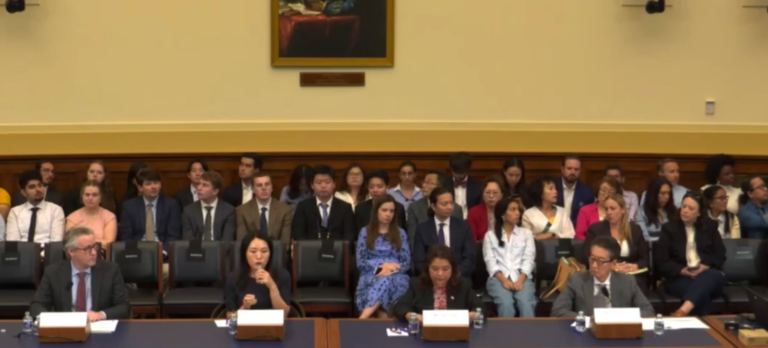
Addressing the U.N. General Assembly’s Third Committee in New York on Tuesday, October 27, Currie said the military had intensified attacks during Min Aung Hlaing’s announced 100-day plan to restore peace and prosperity. She described the military as the greatest source of civilian suffering in Myanmar.
During the committee’s interactive dialogue, China’s representative rejected her claims and cautioned against misleading the public. The representative argued that international efforts should help resolve differences rather than intensify tensions, according to U.N. meeting coverage.
Speaking at a separate event on Wednesday, October 28, supported by the missions of Panama, Switzerland, and Australia, Currie addressed Beijing’s objection directly.
“Some of you who were in the interactive dialogue may have heard the Chinese delegation complaining that I made false statements about them,” she said.
The disputed statement, she explained, was her characterization of China as the decisive enabler of Myanmar’s armed conflict.
“I invited them to please provide me with information that they are not the decisive enabler of this armed conflict. I would love to see it,” Currie said. “But they are.”
She said identifying those responsible and increasing the costs of their involvement were essential. Countries should not be allowed to hide behind diplomatic niceties when their responsibility for civilian deaths in Myanmar was at issue, she argued.
Following the money
Currie placed illicit financial flows at the center of her approach, describing them as critical to the military’s survival, weapons purchases, and ability to wage war against its own population.
Those flows also sustain the patronage and crony networks underpinning military rule while the regular economy deteriorates, she said.
Her proposed scrutiny extends beyond governments to businesses and services connected to Myanmar’s conflict economy: companies sourcing critical minerals, banks, peer-to-peer financial networks and social media platforms that allow illicit activities to thrive.
The aim, she said, is to identify where these activities connect to the global economy and raise the costs for those involved, whether knowingly or unknowingly.
A crisis reaching beyond ASEAN
Currie also called for wider international engagement, arguing that Myanmar’s crisis could no longer be treated primarily as a problem for ASEAN and neighboring countries to manage.
Human trafficking into scam centers, forced labor and cross-border illicit economies have drawn people and financial networks from far beyond Southeast Asia into the crisis, she said.
She cited people trafficked from African and Latin American countries into Myanmar, alongside connections between illicit economies and the Middle East. Scam operations based in Myanmar also victimize people worldwide.
“This is not just a regional problem,” she said.
Currie argued that these expanding international consequences made the case for treating Myanmar as a threat to international peace and security clearer than ever.
Broadening international engagement would be a priority of her mandate, she said, even as other conflicts compete for global attention.
Protecting civilians and backing women’s organizations
Alongside pressure on the military’s financial networks, Currie emphasized direct support for organizations protecting civilians.
She highlighted early-warning systems, counseling for survivors of conflict-related sexual violence, education for children living through war, and documentation of abuses.
These organizations need resources both to protect their communities and to continue gathering the evidence that she and other human rights experts rely on, she said.
Women’s organizations, in particular, were often ahead of other actors in understanding conditions on the ground, organizing communities and advancing national and political reconciliation.
Currie pledged to incorporate gender across her mandate, including scrutiny of women’s experiences in forced-labor networks and the economic circumstances of households headed by women.
She also stressed that accountability for conflict-related sexual violence must extend to resistance forces and other armed groups.
Being better than the military was “a pretty low bar,” Currie said, adding that she wanted those groups to exceed it by as much as possible.
She closed by urging donors to strengthen support for women’s organizations working on the ground.
“I can’t do my work without them,” she said. “And Myanmar’s future will be better if they are able to do their work with stronger support.”