Myanmar Genocide Verdict Is Historic, but Justice Remains Elusive, Expert Says
International law expert Michael Becker calls the decision monumental but warns that enforcing the judgment and delivering justice to Rohingya survivors will be difficult while Myanmar’s military remains in power.
The International Court of Justice (ICJ), the United Nations’ highest court, ruled Thursday that Myanmar committed genocide against the Rohingya Muslim minority during its 2017 military operations in northern Rakhine State, delivering a landmark judgment that establishes the country’s responsibility for atrocities that drove hundreds of thousands of people from their homes.
In a 9–6 decision, the 15-member court found Myanmar in violation of the 1948 Convention on the Prevention and Punishment of the Crime of Genocide, marking the first time the ICJ has held a state directly responsible for committing genocide.
Reading the judgment at the Peace Palace in The Hague, ICJ President Yuji Iwasawa announced that the court “finds that the Republic of the Union of Myanmar has committed genocide against the Rohingya group in northern Rakhine State.”
The court also found that Myanmar had failed to prevent genocide and punish those responsible and ordered the country to provide reparations to Rohingya victims, facilitate the safe return of refugees, and take steps to prevent further violations.
Michael Becker, Assistant Professor of Law at Trinity College Dublin, Ireland, described the ICJ’s ruling as a breakthrough in international justice.
“This is a historic, monumental decision,” Becker told Myanmar Global Media (MGM) in an interview Thursday.
He said the ruling was particularly significant because it demonstrated that states could be held accountable for genocide despite the exceptionally demanding legal requirements.
“For some of us, it seemed as if it was almost impossible, practically speaking, to meet the various requirements to establish genocide,” Becker said.
“So this case proves that, no, it is possible to hold states accountable for this most serious of crimes.”
Court Finds Evidence Supports 10,000 Rohingya Deaths
The judges concluded that evidence supported an estimate of approximately 10,000 Rohingya violently killed during Myanmar’s 2017 military operations, commonly described by Myanmar authorities as clearance operations.
The court found that Myanmar’s security forces committed indiscriminate killings, executions, rape and widespread sexual violence, including attacks against women, children and civilians fleeing toward Bangladesh.
It also cited estimates that between 730 and 2,109 Rohingya children under the age of five died as a result of violence during the operations.
The judges examined evidence that all or parts of 392 Rohingya villages were burned and 78 villages subsequently bulldozed. Some destroyed settlements were replaced with security installations, new villages and other infrastructure.
More than 700,000 Rohingya fled to neighboring Bangladesh during the crackdown, joining those displaced by earlier violence.
The court found that Myanmar committed three categories of prohibited acts under Article II of the Genocide Convention: killing members of a protected group, causing serious bodily or mental harm, and imposing measures intended to prevent births within the group.
It also affirmed that the Rohingya constitute a distinct ethnic group protected under the convention.
Myanmar’s Counterinsurgency Defense Rejected
The central legal question was whether Myanmar’s military acted with the specific intent to destroy the Rohingya as a group, in whole or in substantial part.
Myanmar argued that its operations were a response to attacks by the Arakan Rohingya Salvation Army (ARSA), an armed group that attacked security installations in August 2017.
The court acknowledged those attacks but rejected Myanmar’s explanation that the subsequent military campaign was solely a counterinsurgency operation.
It found that the execution of Rohingya men and boys, widespread sexual violence, targeting of children, systematic destruction of villages and attacks against fleeing civilians were inconsistent with genuine counterinsurgency objectives.
Myanmar also argued that its forces intended to forcibly displace the Rohingya or punish the population for ARSA’s activities.
The court rejected those arguments as reasonable alternative explanations for the totality of the evidence.
It concluded that the only reasonable inference was an intention to destroy a substantial part of the Rohingya population in northern Rakhine State.
In assessing genocidal intent, the judges considered longstanding discrimination, denial of citizenship, restrictions on movement, military-sponsored hate speech and the systematic nature of the 2017 operations.
Divided Judgment Raises Legal Questions
Although the majority found Myanmar responsible for genocide, six judges opposed the central finding.
The dissenting judges raised questions about whether the evidence met the strict legal standard required to establish genocidal intent.
Becker said the 9–6 division was disappointing but did not diminish the judgment’s legal significance.
“I don’t think it undermines the strength of this decision in particular,” he said.
However, he warned that Myanmar’s military authorities could use the dissenting opinions to challenge the judgment’s credibility and weaken international efforts to secure compliance.
He said a broader consensus among the judges would have made the decision more politically powerful.
The disagreement, Becker explained, largely concerned the legal classification of the atrocities rather than whether Myanmar’s security forces had committed widespread abuses.
Court Orders Accountability and Reparations
Beyond the central genocide finding, the ICJ issued 13 operative rulings addressing Myanmar’s obligations under international law.
By an 11–4 vote, the court found that Myanmar failed to fulfill its duty to punish genocide and related offenses.
By 13–2, it ordered Myanmar to promptly and effectively investigate suspected perpetrators and, where warranted, prosecute and punish them.
The court also found, by 14–1, that Myanmar had failed to enact domestic legislation fully implementing the Genocide Convention.
In a separate 14–1 finding, however, the judges concluded that the evidence did not establish Myanmar’s responsibility for directly and publicly inciting private individuals to commit genocide, despite documented military-linked hate speech.
The court ordered Myanmar to facilitate the safe, voluntary and dignified return of displaced Rohingya, restore lost property, assist in locating missing persons and provide physical and psychological rehabilitation.
It also ruled that Myanmar must provide compensation for losses that cannot be remedied through restitution.
Myanmar has two years to report on the restitution measures it has adopted and proposed compensation arrangements. The court will subsequently determine the amount and modalities of compensation or other appropriate reparations.
Becker emphasized that the judgment on the merits does not conclude all proceedings in the case.
“The case isn’t over. This is the judgment on the merits, but the case is still with the ICJ,” he said.
He explained that determining financial compensation remains an important part of the next phase.
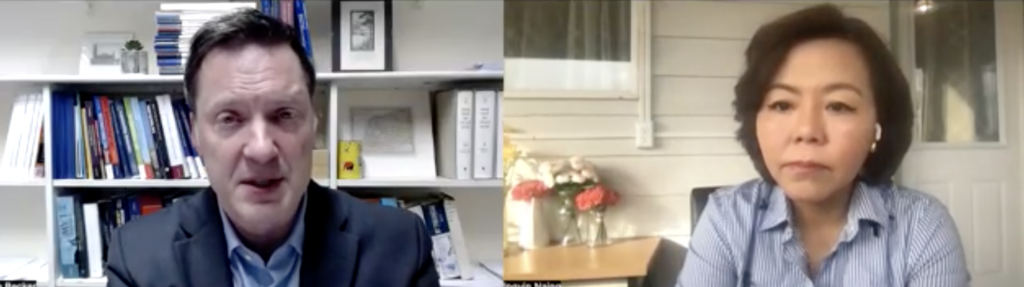
In this screenshot from a Zoom interview on November 19, 2026, Michael Becker (left), Assistant Professor of Law at Trinity College Dublin, Ireland, discusses the ICJ’s historic Myanmar genocide ruling and its implications with Ingyin Naing (right) of Myanmar Global Media (MGM).
Enforcement Remains the Biggest Challenge
Despite the historic ruling, Becker expressed serious doubts that Rohingya survivors would receive immediate material relief.
“It’s difficult to see how, in the short term or even the medium term, how the judgment will provide the Rohingya with any kind of material or practical relief,” he said.
Becker noted that Myanmar remains engulfed in armed conflict and that much of Rakhine State is now under the control of the Arakan Army, complicating prospects for refugee repatriation.
Even if Myanmar’s authorities were willing to comply with the judgment, he questioned whether they currently had the capacity to ensure safe returns.
He said international pressure would therefore be essential.
Among the available measures, Becker identified economic sanctions, diplomatic pressure and greater scrutiny of governments that continue to maintain economic and political relations with Myanmar’s military authorities.
He also questioned efforts to restore the military government’s international standing, including within the Association of Southeast Asian Nations.
Becker said the UN Security Council could, in principle, take steps to enforce the judgment, including requiring countries to impose sanctions.
However, he warned that divisions among permanent Security Council members, particularly the veto powers of China and Russia, could obstruct meaningful action.
“In terms of what happens to Myanmar if they don’t comply, there are limits,” Becker said.
“But it depends on states having the political will to try to make non-compliance costly.”
The case continued despite Myanmar’s February 2021 military coup, underscoring that the legal obligations of a state remain in force regardless of changes in government.
Could Myanmar’s Military Leaders Face Prosecution?
The ICJ judgment determines Myanmar’s legal responsibility as a state, rather than the criminal responsibility of individual military commanders.
Becker said the ruling could nevertheless strengthen efforts to prosecute military leaders in national courts exercising universal jurisdiction.
He explained that separate proceedings at the International Criminal Court (ICC) are limited by jurisdictional questions, while a broader Security Council referral of Myanmar to the ICC remains politically unlikely.
The ICJ’s finding that genocide occurred could encourage national prosecutors pursuing cases against Myanmar military officials, Becker said.
However, he emphasized that such prosecutions would face practical obstacles, including the need to obtain custody of suspects.
The judgment could also impose further restrictions on where military leaders can safely travel, he suggested.
Asked about the responsibility of Myanmar’s former civilian government under Aung San Suu Kyi, who defended Myanmar before the ICJ in 2019, Becker said that international law does not separate the military from civilian authorities when determining the responsibility of the state.
“The state is the state,” he said.
“The state is ultimately responsible, and we don’t kind of separate the government from the military at the level of international responsibility.”
Historic Recognition, but Justice Still Uncertain
The Gambia filed the case against Myanmar in November 2019, supported by the Organisation of Islamic Cooperation.
In January 2020, the ICJ ordered Myanmar to protect the Rohingya from acts of genocide and preserve relevant evidence.
The court rejected Myanmar’s preliminary objections in July 2022, and hearings on the merits took place in January 2026.
Thursday’s ruling is final and legally binding, although the ICJ has no independent enforcement mechanism.
Becker, who had advocated exploring the ICJ as a legal avenue for Rohingya accountability years before the judgment, said the outcome reflected sustained efforts by civil society organizations and members of the Rohingya community.
He emphasized that the decision provides important recognition to survivors even if tangible relief remains distant.
“I hope that the ruling itself … provides a measure of dignity, that it’s a kind of recognition that the Rohingya matter, that the world has not forgotten about the Rohingya,” he said.
But he cautioned that symbolic recognition alone would not rebuild destroyed communities or improve conditions in refugee camps.
Looking ahead, Becker called on governments, international organizations and civil society groups to use the judgment as a foundation for sustained pressure and practical assistance.
“The judgment needs to be seen as a tool, a reference point, a political marker,” he said.
For the Rohingya, the ruling establishes a historic legal acknowledgment of genocide. Whether it leads to accountability, compensation and safe repatriation remains uncertain.
Becker said the international community must now turn that legal victory into practical action.
“States should commit themselves to doing what they can to making this happen,” he said.